
IIT JAM vs GATE: Which Exam Should You Choose After a BSc?

|
Getting your Trinity Audio player ready...
|
Every year, thousands of BSc graduates reach the same crossroads. Should you appear for IIT JAM, or should you attempt GATE instead? Both exams are conducted by the IITs. Both open doors to postgraduate study. Yet they serve very different purposes, and picking the wrong one can quietly cost you a full year of preparation. This guide breaks down the real differences between IIT JAM vs GATE across eligibility, syllabus, pattern, cost, and career outcomes, for every subject JAM offers, not just Mathematics.
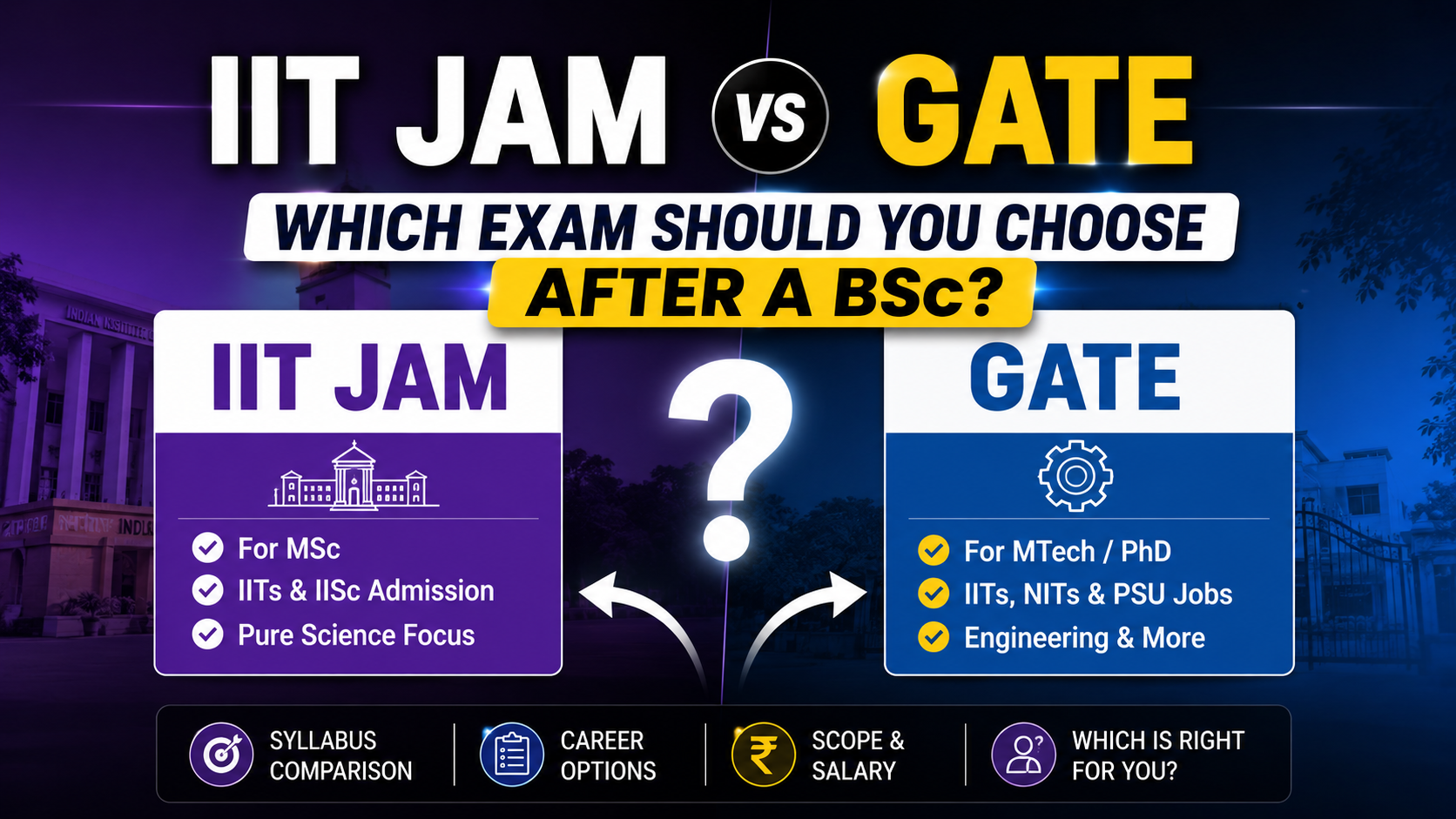


Quick Snapshot: IIT JAM vs GATE at a Glance
Before the details, here’s the short version. IIT JAM is meant for BSc graduates who want to join an MSc, Joint MSc-PhD, or MS by Research program. GATE, meanwhile, is primarily built for engineering graduates pursuing an MTech, though it also accepts BSc graduates in select science papers. JAM leads only to academic admissions. GATE leads to MTech admissions, PhD eligibility, and PSU recruitment as well.
If your goal is a focused MSc in a pure science subject, JAM usually fits better. If you want broader flexibility across research, industry, and government recruitment, GATE deserves serious consideration too.
What Is IIT JAM?
IIT JAM, or the Joint Admission Test for Masters, is a national-level exam conducted by the IITs, in rotation, for admission into MSc and related postgraduate programs at IITs and IISc Bangalore. It is offered across seven subjects: Biotechnology, Chemistry, Economics, Geology, Mathematics, Mathematical Statistics, and Physics.
The exam tests subject knowledge purely at the BSc level. There’s no engineering mathematics section, no general aptitude component, and no interdisciplinary overlap. It simply checks how well you understand your core subject.
What Is GATE?
GATE, or the Graduate Aptitude Test in Engineering, is a much larger exam conducted for 30 test papers across engineering, science, and humanities disciplines. While it’s best known among engineering students, several of its science papers directly overlap with JAM subjects, including Mathematics, Physics, Chemistry, Biotechnology, and Geology and Geophysics. GATE also added a dedicated Statistics paper in recent years, which aligns closely with JAM’s Mathematical Statistics.
Unlike JAM, every GATE paper includes a compulsory General Aptitude section worth 15 marks. This means GATE candidates prepare verbal and quantitative aptitude regardless of their subject, something JAM never requires.
Subject-Wise Mapping: Which GATE Paper Matches Your JAM Subject
Not every JAM subject has a direct GATE equivalent, so here’s how they line up.

Mathematics in JAM corresponds to the GATE Mathematics paper, coded MA.
Physics in JAM corresponds to GATE Physics, coded PH.
Chemistry in JAM corresponds to GATE Chemistry, coded CY.
Biotechnology in JAM corresponds to GATE Biotechnology, coded BT.
Geology in JAM corresponds to GATE Geology and Geophysics, coded GG.
Mathematical Statistics in JAM corresponds to the GATE Statistics paper, coded ST.
Economics in JAM has no direct GATE match, though GATE’s Humanities and Social Sciences paper includes an Economics section as one of its optional choices.
In short, five of the seven JAM subjects have a near-identical GATE counterpart. This makes cross-preparation genuinely realistic for most JAM aspirants.
Eligibility: Who Can Apply for Each Exam
IIT JAM Eligibility
You need a Bachelor’s degree with your chosen subject as a major, along with a minimum aggregate score, typically 55 percent for general category and 50 percent for SC, ST, and PwD candidates. Final-year students can apply provisionally.
GATE Eligibility
Eligibility has become noticeably more flexible in recent years. Candidates in their third year of a BSc or engineering program can now appear, in addition to final-year students and graduates. There’s no minimum percentage requirement for GATE, unlike JAM. As a result, more students qualify to attempt GATE earlier in their academic journey.
Neither exam has an upper age limit, and both allow unlimited attempts.
Application Process and Fees
Both exams follow a similar online process: registration, document upload, paper selection, and fee payment, all through their respective portals. JAM uses the JOAPS portal, while GATE uses its own dedicated application system managed by the organizing IIT.
Fee-wise, the two exams are broadly comparable for a single paper, typically in the range of 1,500 to 1,800 rupees for general category candidates, with a reduced fee for female, SC, ST, and PwD applicants. Both exams also allow you to apply for two papers, though the combination rules differ.
Exam Pattern: A Detailed Comparison
Both exams run for three hours and carry 100 marks. Both use a mix of Multiple Choice Questions (MCQ), Multiple Select Questions (MSQ), and Numerical Answer Type (NAT) questions, and negative marking applies only to the MCQ section in each.
The real difference lies in structure. JAM tests only your chosen subject, with a syllabus based entirely on BSc-level topics. GATE, on the other hand, allocates 15 marks to a compulsory General Aptitude section, testing verbal ability, quantitative reasoning, and analytical thinking, on top of your subject paper. For engineering-adjacent science papers like Mathematics and Statistics, GATE also often includes a small Engineering Mathematics component alongside the core subject.
This means GATE candidates carry an extra preparation load that JAM candidates simply don’t have to worry about.

Syllabus Comparison Across Subjects
Mathematics
Both exams cover Real Analysis, Linear Algebra, Differential Equations, and Group Theory, though GATE Mathematics leans slightly more toward applied and computational problem-solving, while JAM stays closer to pure theory.
Physics
JAM focuses on Mechanics, Electromagnetism, Optics, Modern Physics, and Thermodynamics at the BSc level. GATE Physics covers similar ground but adds more emphasis on quantum mechanics and solid-state physics at a slightly deeper level, since it also serves MTech and PhD aspirants.
Chemistry
JAM tests Physical, Organic, and Inorganic Chemistry broadly. GATE Chemistry covers the same three branches but expects sharper application-based problem-solving, reflecting its dual use for MTech admissions and PSU recruitment.
Biotechnology
JAM stays within core BSc biotechnology topics. GATE Biotechnology extends into bioprocess engineering and applied biotechnology, since many GATE Biotechnology candidates go on to MTech programs with an industry focus.
Geology
JAM covers structural geology, mineralogy, and stratigraphy at BSc level. GATE’s Geology and Geophysics paper adds geophysics, geomathematics, and exploration techniques, making it noticeably broader in scope.
Mathematical Statistics
JAM covers probability, random variables, and standard distributions. GATE’s Statistics paper overlaps heavily here but places more weight on estimation theory and applied statistical methods.
Difficulty Level: Which Exam Is Tougher
This depends heavily on your subject and your comfort with aptitude-based questions. JAM is generally considered more manageable for BSc graduates, since it stays within a familiar syllabus without any surprise sections.
GATE, however, tends to attract a much larger and more diverse applicant pool, including engineering graduates competing for the same core subject papers. The compulsory aptitude section adds another layer of preparation that many BSc students find unfamiliar at first. As a result, GATE often feels more competitive in absolute terms, even when the core subject difficulty is similar.
Career Outcomes: Where Each Exam Actually Leads
This is the section that matters most. IIT JAM leads exclusively to academic admissions, specifically MSc, Joint MSc-PhD, and MS by Research programs at IITs and IISc. There’s no alternate use for a JAM score outside admissions.

GATE, meanwhile, opens three distinct paths. It gets you into MTech and PhD programs, of course, but it also qualifies you for direct recruitment into major public sector undertakings (PSUs), along with financial support through fellowships during MTech and PhD study. For subjects like Biotechnology, Geology, and Chemistry, GATE-based PSU recruitment is a significant career route that JAM simply doesn’t offer.
If your ambition includes government sector jobs or PSU recruitment alongside academics, GATE carries clear additional value.
Should You Prepare for Both Exams?
For most JAM subjects, yes, and many serious aspirants already do this. Since the core syllabus overlaps by roughly 60 to 70 percent across Mathematics, Physics, Chemistry, Biotechnology, and Statistics, preparing for JAM first and then extending into GATE’s aptitude section and applied topics is an efficient, low-waste strategy.
Economics is the one subject where this overlap breaks down, since GATE has no direct equivalent paper.
How to Decide: A Simple Framework
Choose IIT JAM if your goal is a focused MSc at an IIT or IISc, followed by research or academia, and you’d rather avoid preparing a separate aptitude section.
Choose GATE if you want flexibility across MTech, PhD funding, and PSU recruitment, or if you’re still unsure which direction your career should take.
If you’re in Mathematics, Physics, Chemistry, Biotechnology, Geology, or Statistics, and you have the preparation bandwidth, attempting both exams is a genuinely sound strategy, given how much syllabus they share.
Frequently Asked Questions
Can a BSc student apply for both IIT JAM and GATE?
Yes, there’s no restriction preventing you from applying for both exams in the same year, as long as you meet each exam’s individual eligibility criteria.
Which exam is better for a BSc Mathematics student, JAM or GATE?
It depends on your goal. JAM suits students aiming for a direct MSc, while GATE suits students who also want MTech, PhD funding, or PSU recruitment as options.

Does GATE have papers for every JAM subject?
Almost. GATE offers matching papers for Mathematics, Physics, Chemistry, Biotechnology, and Geology and Geophysics, plus a Statistics paper close to JAM’s Mathematical Statistics. Economics is the one exception, with no direct GATE equivalent.
Is GATE harder than IIT JAM?
GATE generally involves a larger applicant pool and an additional compulsory aptitude section, which makes it feel more demanding for many BSc students, even though the core subject syllabus overlaps significantly with JAM.
Can I get a PSU job through IIT JAM?
No, IIT JAM scores are used only for academic admissions. PSU recruitment is a GATE-specific pathway, unavailable through JAM.
Which exam should Economics graduates choose?
IIT JAM is the more direct path for Economics graduates, since GATE has no dedicated Economics paper, only an optional Economics section within its Humanities and Social Sciences paper.
Conclusion
IIT JAM and GATE aren’t competing exams; they’re built for different goals. JAM gives you a direct, subject-focused route into a strong MSc program. GATE gives you a wider net, spanning MTech admissions, PhD funding, and PSU recruitment, at the cost of an extra aptitude section to prepare for. For most science subjects, since the syllabus overlap is substantial, the smarter move isn’t choosing one over the other. It’s understanding which exam serves your immediate goal, and treating the other as a strong backup that your existing preparation already supports.

Pdakoo
India's Growing Learning PlatformPrepare smarter with live classes, structured courses, mock tests, quizzes, and mentorship for competitive exams.
Live Classes
Interactive sessions with expert educators.
Courses
IIT-JEE, NEET & competitive exam preparation.
Mock Tests
Practice with quizzes and test analysis.
Mentorship
Guidance from mentors and educators.



10,000+ Students
Trusted across India 🇮🇳