
IIT vs IISc for MSc: Which JAM Institute Should You Choose?

|
Getting your Trinity Audio player ready...
|
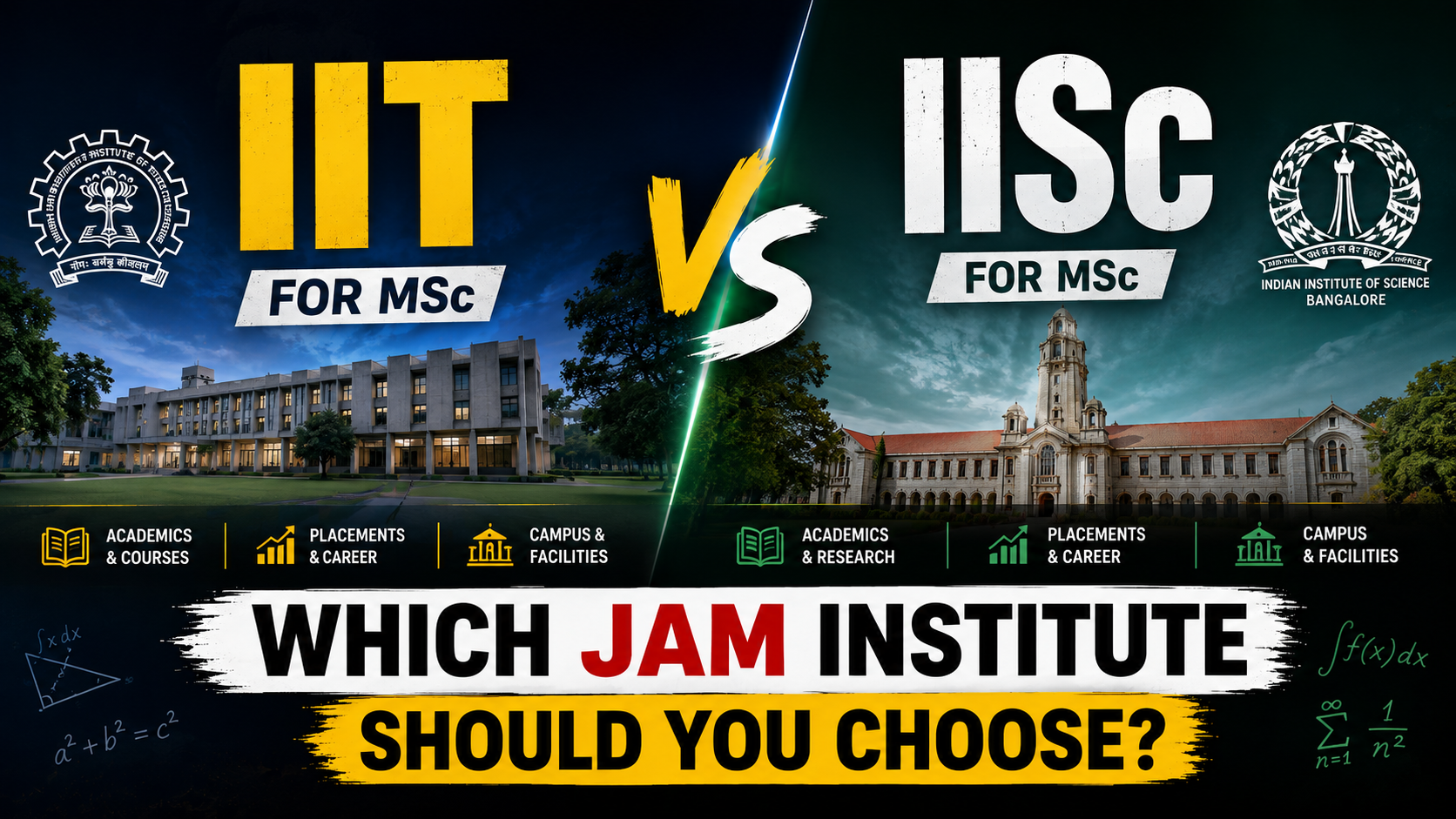
Clearing IIT JAM is only half the journey. The next decision, choosing between an IIT and IISc Bangalore during JOAPS counselling, matters just as much. Both are excellent, but they run genuinely different academic models, and the right choice depends heavily on your subject and your long-term goal. This guide breaks down IIT vs IISc in detail, across academic structure, subjects offered, research exposure, and placements, so you can make an informed choice when your JAM rank comes through.


Quick Snapshot: IIT vs IISc at a Glance
Before the details, here’s the short version. IITs generally offer a straightforward, coursework-based 2-year MSc program with structured semesters and defined exams. IISc, on the other hand, has traditionally offered admission through JAM into its Integrated PhD program, a longer, research-first track, though it has now also introduced a dedicated 2-year MSc in select disciplines.
If you want a well-defined MSc with strong placement support, IITs are usually the safer choice. If you’re certain about a research career and want early exposure to that path, IISc offers a more direct route, especially in the subjects it now covers.
How IIT JAM Admission Works at Each Institute
At IITs, IIT JAM directly admits you into a 2-year MSc, Joint MSc-PhD, or MSc-PhD Dual Degree program, depending on the institute and subject. The process is rank-based, and you select your preferred IIT and subject during JOAPS counselling.
At IISc, the traditional JAM-linked pathway has been the Integrated PhD program, spanning multiple science disciplines. More recently, IISc launched a new 2-year MSc program as well, currently offered in Life Science, Chemical Science, and Physics. For Chemical Science, admission is purely JAM rank-based. For Life Science, JAM or GATE rank shortlists you for an interview, and final selection depends on interview performance. This distinction matters, since it means IISc’s admission process isn’t always purely rank-driven the way IIT admissions typically are.
Subjects Offered: IIT vs IISc
This is where the two institutes diverge the most, and it directly affects your choice.
Mathematics is widely available across most IITs through a standard 2-year MSc. IISc’s Mathematics route, where available, generally sits within its Integrated PhD structure rather than a standalone MSc.
Physics is offered at IITs as a 2-year MSc, and at IISc through both the Integrated PhD and the newer 2-year MSc program.

Chemistry follows a similar pattern: IITs offer a standard MSc, while IISc now offers a dedicated 2-year MSc in Chemical Science, purely rank-based on your JAM score.
Biotechnology and Life Sciences are available at IITs as MSc programs, and at IISc through the Integrated PhD track, plus the new Life Science MSc, which includes an interview stage.
Geology and Mathematical Statistics are offered at select IITs, but IISc’s JAM-linked programs don’t currently extend to these subjects in the same way.
Economics is offered at a few IITs, but has no direct IISc pathway through JAM.
In short, if your subject is Chemistry, Physics, or Life Sciences, IISc is a genuine option worth comparing. For Geology, Mathematical Statistics, and Economics, IITs remain your primary route.
Academic Structure and Focus
IITs generally run a structured, coursework-heavy MSc, with defined semesters, periodic exams, and a curriculum built around core subject mastery over two years. This structure suits students who want a clear academic roadmap.
IISc, by contrast, is fundamentally a research institute. Its Integrated PhD track pushes students toward research exposure early, often before they formally begin doctoral work. Even its newer 2-year MSc programs carry a stronger research orientation than a typical IIT MSc, since research culture runs through everything IISc does.
Research Exposure and Faculty
Both IITs and IISc have strong faculty across the sciences. That said, IISc’s research intensity is arguably sharper, since the institute exists primarily to produce PhD scholars and postdoctoral researchers. MSc and Integrated PhD students there often get early access to active research groups, seminars, and ongoing projects.

At IITs, research exposure varies by campus and department. Older, more established IITs, such as IIT Bombay, IIT Delhi, and IIT Kanpur, tend to have deeper research ecosystems in the sciences compared to some of the newer IITs.
Placement and Career Outcomes
This is a common point of confusion, so it’s worth being direct about it. IITs generally offer stronger placement support for MSc science graduates, including roles in analytics, data science, and quantitative or technical positions in the private sector.
IISc is far less placement-focused, and its programs, whether Integrated PhD or the newer MSc, don’t come with a stipend the way many PhD tracks do. It’s oriented toward producing PhD candidates and future academics, not entry-level industry hires. For context, IISc’s placement data skews heavily toward candidates from its more established programs, and outcomes for the newer MSc cohorts are still developing.
If you want strong placement options right after your MSc, an IIT is typically the safer choice. If your goal is a PhD and an eventual research career, IISc offers a more direct pipeline, particularly in Physics, Chemistry, and Life Sciences.
Campus Life and Location
IITs are spread across India, from Mumbai and Delhi to Guwahati, Roorkee, and beyond, so your campus experience varies widely depending on location, culture, and campus size.
IISc, meanwhile, is a single campus in Bangalore, known for its concentrated research atmosphere and closely knit academic community. There’s no location choice involved, since it’s one campus for every subject it offers.
For students who want variety in city, culture, or campus scale, IITs offer more choice. For students who want one focused, research-first environment, IISc stands alone.
How to Decide Based on Your JAM Rank and Subject
Your JAM rank decides how much choice you actually have, but your subject decides whether IISc is even on the table. Start by checking whether IISc offers a JAM-linked program in your subject at all — currently, that means Physics, Chemistry, and Life Sciences.

Top-ranking candidates in these subjects can genuinely choose between older IITs and IISc. Mid-range rank holders often get strong options among newer IITs, which is still a solid outcome. For Mathematics, Geology, Mathematical Statistics, and Economics candidates, your comparison is really between different IITs, since IISc’s options are limited or unavailable in these subjects.
Which Should You Choose?
Choose IISc if your long-term goal is a PhD and a research career, your subject is Physics, Chemistry, or Life Sciences, and you want early exposure to a research-first environment, even without placement support or a stipend during your MSc years.
Choose an IIT if you want a balanced MSc experience with strong placement options, a defined coursework structure, and the flexibility to decide on research later, or if your subject isn’t currently offered through IISc’s JAM-linked programs at all.
Neither option is objectively better. The right choice depends on where you see yourself in five years, your subject, and whether you’re ready to commit to research this early, not just where your JAM rank places you today.
Frequently Asked Questions
Does IISc offer MSc programs for all IIT JAM subjects?
No. IISc currently offers its dedicated 2-year MSc only in Life Science, Chemical Science, and Physics. Other subjects, where available at IISc, generally fall under its Integrated PhD track instead.
Is admission to IISc through JAM purely rank-based?
Not always. For Chemical Science, admission is purely based on your JAM rank. For Life Science, JAM or GATE rank shortlists you for an interview, and final selection depends on interview performance.
Does IISc’s MSc program offer a stipend?
No, IISc’s 2-year MSc program does not come with a stipend, unlike many of its PhD-track programs, which typically include one.
Which offers better placements after MSc, IIT or IISc?
IITs generally offer stronger placement support for MSc graduates. IISc is less placement-focused and is oriented more toward producing PhD candidates and researchers.

Can I do a PhD after an MSc from an IIT?
Yes, many IIT MSc graduates go on to pursue a PhD, either at the same institute or elsewhere, based on their research interests and exam performance.
Is IISc better than IITs for Mathematics through JAM?
Not directly comparable in most cases, since IISc’s JAM-linked programs currently focus on Physics, Chemistry, and Life Sciences. For Mathematics, IITs remain the primary route through JAM.
Conclusion
IIT vs IISc isn’t a simple better-or-worse comparison — it depends entirely on your subject, your rank, and how early you’re ready to commit to a research career. IITs offer a broader subject range, structured coursework, and stronger placement support. IISc offers a sharper research environment, but only in select subjects, and without the placement safety net an IIT provides. Once your JAM result is out, check subject availability first, then weigh research intensity against placement support, rather than choosing based on institute reputation alone.

Pdakoo
India's Growing Learning PlatformPrepare smarter with live classes, structured courses, mock tests, quizzes, and mentorship for competitive exams.
Live Classes
Interactive sessions with expert educators.
Courses
IIT-JEE, NEET & competitive exam preparation.
Mock Tests
Practice with quizzes and test analysis.
Mentorship
Guidance from mentors and educators.



10,000+ Students
Trusted across India 🇮🇳